Ed., with Fred Dallmayr, A World Beyond Global Disorder: The Courage to Hope. Newcastle upon Tyne, UK: Cambridge Scholars Publishing, 2017.

A world which, like ours, has been ravaged by some sixty wars in recent decades, can rightly be described as the scene of global disorder. Even today, the same world is traumatized by hot and cold wars, proxy wars, and repeated outbursts of blood-filled mayhem, not to mention the threat of a nuclear holocaust unleashed by big power rivalries. These are not mere statistics, but wounds in the body of humanity, calling for healing and reconciliation. In biblical terms, human beings are not meant to be the owners or the destroyers of the world, but rather its custodians or caretakers. The book is a summons to responsible care-taking, and it approaches the subject from an intercultural perspective in a variety of fields, including religion and politics. The topics covered range from accounts of major global calamities today to explorations of possible political, economic and societal reforms, and to the invocation of basic religious and philosophical resources needed for the recovery of a world beyond global disorder.
The Quest for Change: From Domination to Dialogue. Berlin: Dialogue of Civilizations Research Institute, 2016.
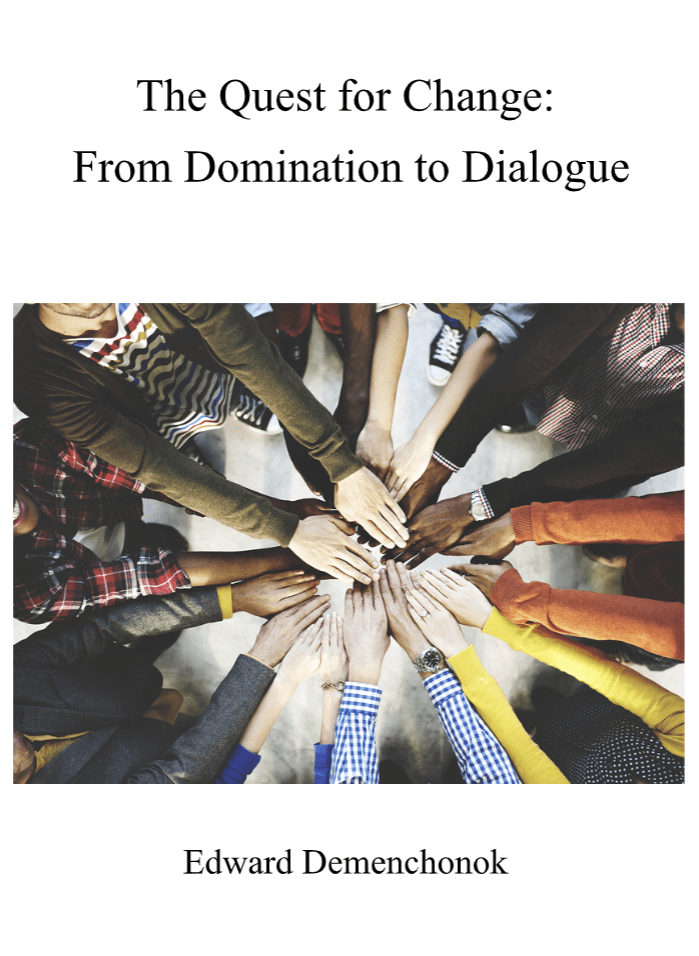
Thе monograph explores the distinction between domination and dialogue. It analyses dialogical philosophy, mainly in the works of Mikhail Bakhtin and some other contemporary authors, grounding the universal character of dialogue as constitutive of human personality itself. Dialogism is a fundamental characteristic of language. In its normative role, dialogism can serve as the standard for the evaluation and critique of existing relationships within a socially and culturally diverse world. It can also serve as a regulative principle in the ennoblement of human relationships. This work highlights intercultural philosophy and its grounding of the ideas of cultural diversity and intercultural dialogue. It analyses the manifestations of cultural diversity in Latin American, African and the African-American philosophies. These philosophies show the tendency to evolve from ethnocentrism to more openness and finally to inter-philosophical global dialogue. Dialogism is opposed to historical-cultural conditions that hinder it. In exploring the historical contradiction between domination and dialogue, the analysis points out its causes, such as calculative “instrumental reason,” colonial exclusion of the other, and the asymmetries of power. The current hegemonic US policy aiming for global domination is at odds with the dialogical and collaborative relationships of sovereign nations as equals. The author argues for the implementation of dialogical relationships within society and in the international arena as well as for the collaboration of peoples, which is necessary to find a solution to social and global problems. The concept of the dialogue of civilizations – asserting a plurality of civilizations – orients us toward the study of intra-civilizational and inter-civilizational relationships, with the aim of fostering dialogue. The enhancement of dialogical relationships is both a condition and an indispensable means of progression toward a more humane, peaceful and just world order.
Ed., Intercultural Dialogue: In Search of Harmony in Diversity. Newcastle upon Tyne, UK: Cambridge Scholars Publishing, 2014, 2016.

Intercultural Dialogue: In Search of Harmony in Diversity offers a philosophical analysis of the issues surrounding cultural diversity and dialogical relationships among cultures as an alternative to “culture wars” and hegemonic globalization. It examines the ideas of dialogue and harmony as expressed in Daoism, Confucianism, Indian, and Ancient Greek philosophical traditions, as well as in contemporary European and Latin-American philosophies. Drawing on the works of Laozi, Confucius, Plato, Kant, and Gandhi, the book shows the importance of intercultural dialogue and the globalization of philosophy. It asserts that intercultural dialogue should have inter-philosophical global dialogue as its epistemological and ontological foundation. Intercultural philosophy elaborates on the conceptualization of philosophy as culturally embedded. Attention is paid to dialogic philosophy, particularly Bakhtin’s dialogism and its contemporary elaboration in the phenomenology of indirect speech, synergic anthropology, and the theory of trans culture. The book offers a critical analysis of world problems. Their possible solutions require a more dialogically-oriented and humane transformation of society. Thus, it is necessary to go beyond instrumental rationality and to be open for cross-cultural and inter-religious dialogue and ethics of co-responsibility, as well as to strengthen international law and institutions, aiming for a gradual realization of the ideal of a cosmopolitan order of law and peace.
Ed., Philosophy After Hiroshima. Newcastle upon Tyne, UK: Cambridge Scholars Publishing, 2010.
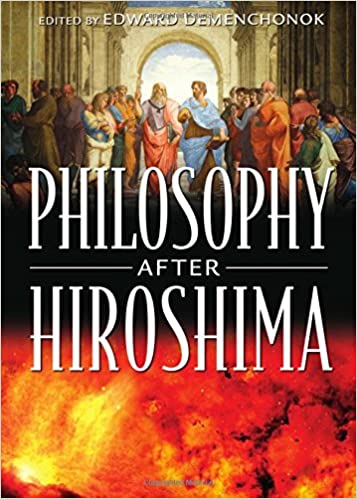
This book offers a philosophical analysis of the issues surrounding war and peace, and their challenges to ethics. It recalls the atomic bombings of Hiroshima and Nagasaki as the beginning of the nuclear age, the Cold War, and subsequently of the American Empire. It traces connections between those events and the present 21st-century wars, such as the U.S. invasion in Iraq and ‘the global war on terrorism’, as a continuation of hegemonic power politics. The book draws on the responses to the emergence of nuclear warfare by Camus, Sartre, Russell, Heidegger, Jaspers, and other philosophers, which help us assess the current escalation of global violence. In the nuclear age, the use of military force as a political instrument threatens the future of humanity. This poses formidable challenges to philosophy and calls for its transformation. The contributors examine the problems of war and peace, human rights, toleration, the politics of memory, intercultural dialogue, the ethics of co-responsibility, and cosmopolitan order. Drawing on a vast range of philosophical traditions – Taoist and Western – they show the relevance of ethics of nonviolence in search for peaceful alternatives. In going beyond postmodernism, the authors develop a post-critical, constructive paradigm of thinking, as a transition from the philosophy of analysis to the philosophy of synthesis and the philosophy of the possible. They outline a new, possibilistic methodology in the humanities based on conceptual constructivism. Philosophy is viewed as a peace-promoting global dialogue.
Ed., Between Global Violence and the Ethics of Peace: Philosophical Perspectives. Malden, MA and Oxford, UK: Willey-Blackwell Publishing, 2009.

The book offers a philosophical analysis of violence as a global problem and its challenges to ethics. In the nuclear age, the use of military force as a political instrument threatens the future of humanity. The contributors examine the problems of structural and direct violence, war and peace, human rights, toleration, and the ethics of international relations and co-responsibility in a globalized world. Drawing on a vast range of philosophical traditions – Taoist, Hellenic, and Western – they show the relevance of ethics of nonviolence in search for peaceful alternatives. They examine Kant’s idea of perpetual peace and its development by the theorists of “discourse ethics” and of “cosmopolitan democracy.” The true solution to the problem of securing peace and protecting human rights can be achieved not by hegemonic unilateralism and force, but only by peaceful means, based on international law and institutions, such as a properly reformed UN.
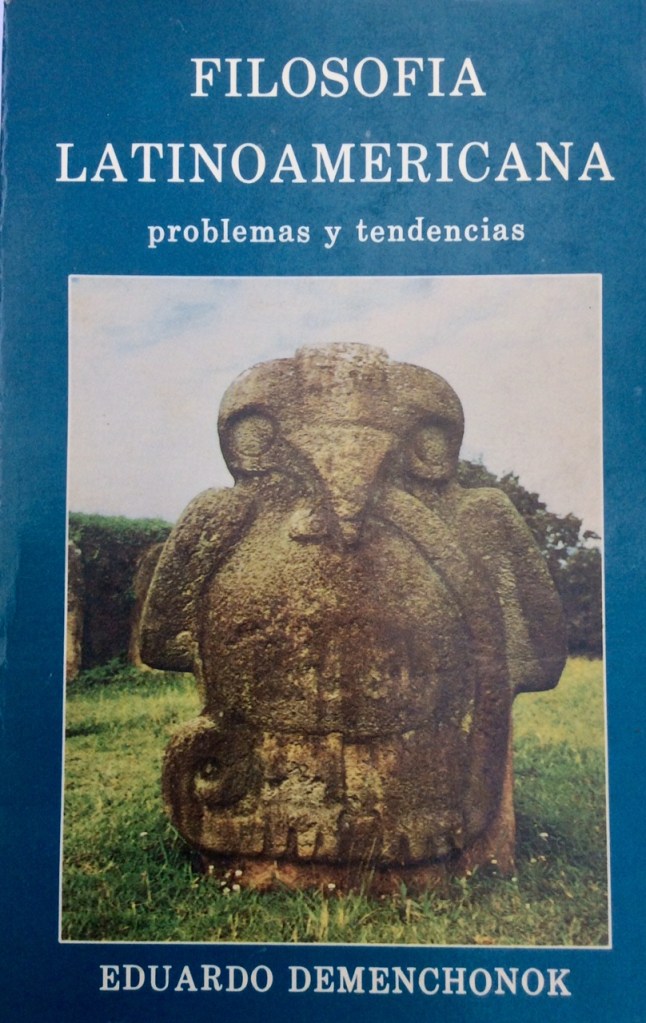
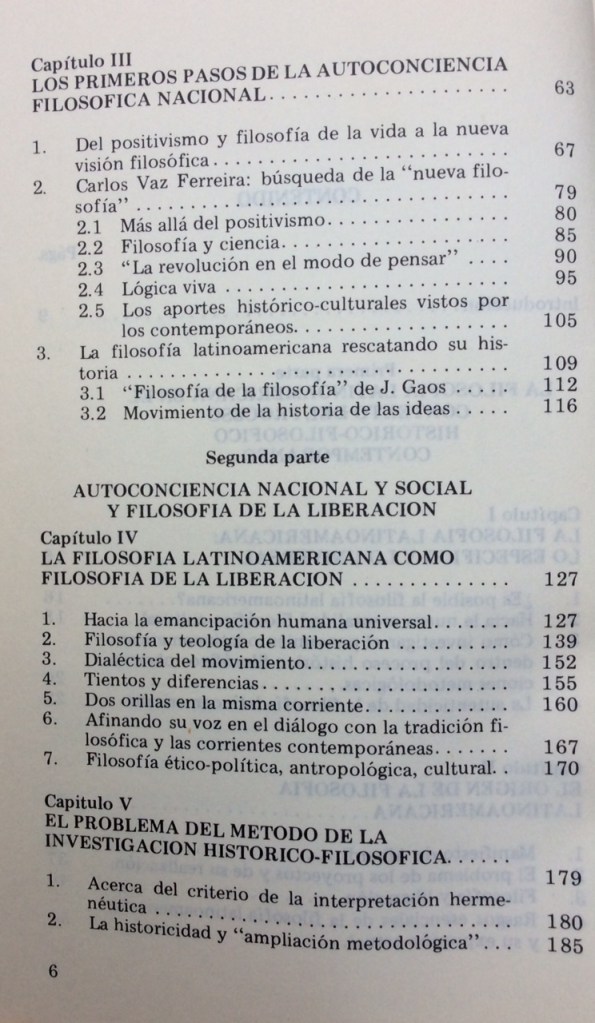
Filosofía Latinoamericana: Problemas y Tendencias. Bogotá: Editorial El Buho, 1990.
En la novela de alejo Carpentier Los pasos perdidos, el protagonista de la misma, un talentoso musicólogo latinoamericano que vive en un ambiente mecanizado y alienante de una de las grandes urbes de EE.UU., regresa a su patria después de muchos anos en cusca de instrumentos musicales primitivos. Para ello, emprende viaje hacia los lugares más recónditos del continente, la selva venezolana del Orinoco y la Amazonia, sumergiéndose en ella por los recovecos más increíbles del espacio geográfico y del tiempo histórico-cultural. En esta odisea el compositor descubre no solo nuevos instrumentos y ritmos, sino lo que es más importante: las raíces originarias del hombre y de la propia cultural latinoamericana y los verdaderos valores humanos perdidos en la complicada civilización mecanizada y alienante del “business,” es decir, de la civilización industrial occidental. Este deslumbrante descubrimiento produce un revolcón en la conciencia del protagonista, de tal manera que de regreso a su antiguo mundo ya no podrá ser más lo mismo, no como hombre ni como artista.

Esta novela realista y a la vez simbólica del gran escritor cubano representa la odisea de tantos intelectuales de América Latina en búsqueda de lo originario de su continente, de su propia cultura e historia. Gracias a ellos, se ha producido en pleno siglo XX un redescubrimiento y revelación de América Latina, ante propios y extraños. La novela, la poesía, la música, la pintura y demás bellas artes han contribuido a la revelación del ser latinoamericano; también la antropología, la sociología y la historia. Como el protagonista de la novela de Carpentier, la intelectualidad latinoamericana vive, después de esta experiencia árquica, en el presente de su propio mundo, al nivel histórico que les corresponde, pero con unos valores recuperados en los cuales tratan de fundamentar su aventura hacia el porvenir.
En este panorama de la cultura latinoamericana, ¿qué significa la filosofía? ¿Es América Latina un continente con ciencia, literatura, artes y música, pero sin filosofía? O, por el contrario, ¿tiene América Latina un pensamiento filosófico propio, creado para solucionar sus problemas? ¿Se puede hablar hoy de una “filosofía latinoamericana? Si es así, ¿cuál ha sido el origen, el proceso y los objetivos de este aspecto tan importante, como desconocido, de la cultura latinoamericana?
En el presente libro me he propuesto responder a esas y otras preguntas, haciendo ver los aciertos y logros del pensamiento latinoamericano, que ciertamente no ha conseguido hasta hoy desarrollarse plenamente, como sí la literatura, pero que no obstante cuenta en su haber con significativos aportes no solo a la comprensión del hombre y de la cultura latinoamericana, sino también al conocimiento de lo humano en general. Lo especifico y lo universal se conjuga así armónicamente en el proyecto y realización de la filosofía latinoamericana.
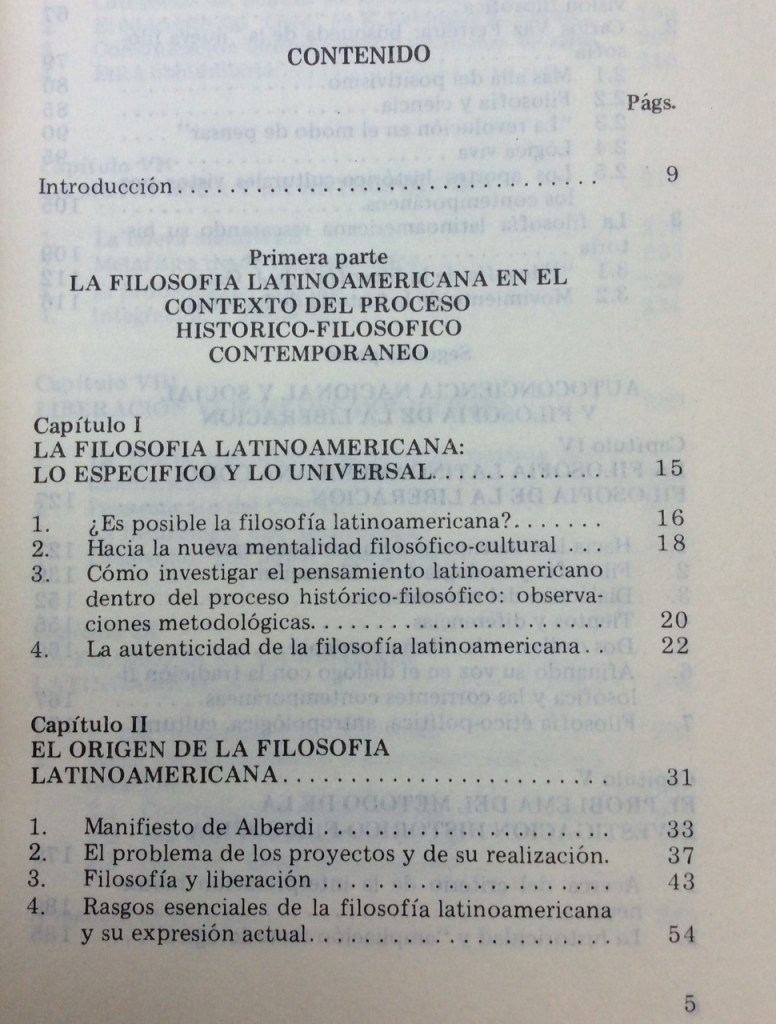
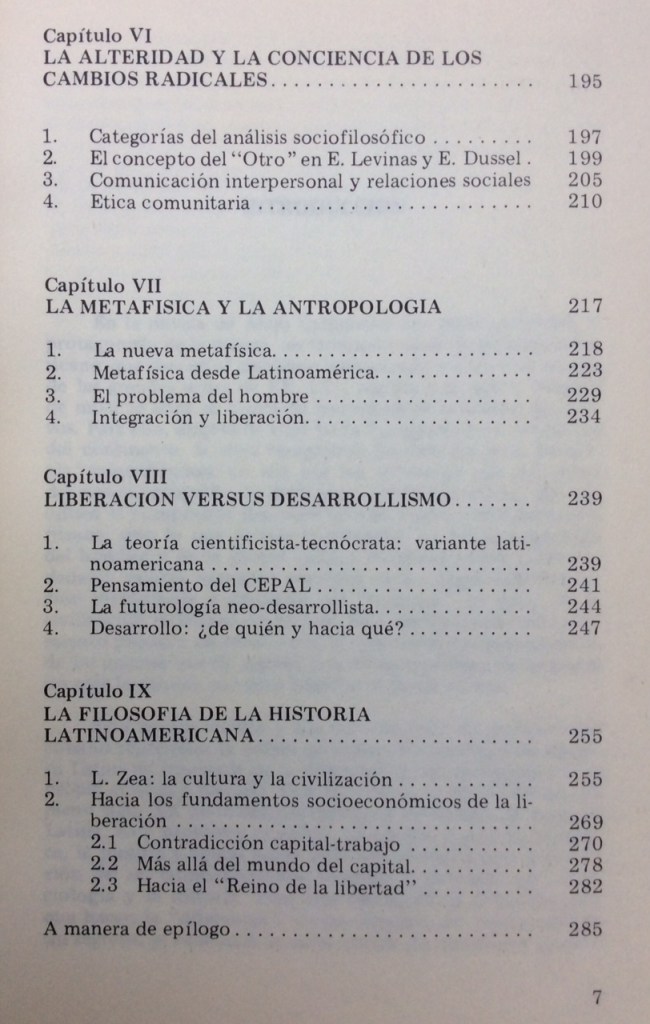
Filosofía en el Mundo Contemporaneo. Bogotá: Editorial UNINCCA, 1990.

CONTENIDO
PRIMERA PARTE
Capítulo I. La antesala del conocimiento filosófico.
Capítulo II. La filosofía contemporánea: Un giro hacia el hombre y la cultura.
Capítulo III. El proceso histórico-filosófico.
SEGUNDA PARTE
Capítulo IV. La filosofía de la liberación humana.
Capítulo V. El progreso que se cuestiona.
Capítulo VI. Los problemas globales y la nueva mentalidad filosófico-política.
TERCERA PARTE
Capítulo VII. América Latina en la época de la revolución científico-técnica.
Capítulo VIII. El pensamiento filosófico en América Latina y la liberación nacional y social.
EPILOGO
Ya al despedirme, quisiera agradecer a Usted, paciente amigo lector, por haberme gentilmente acompañado en este viaje por aquellos círculos dantescos del mundo humano con sus problemas, ideas, pasiones y esperanzas. Al alcanzar la orilla, se siente un alivio pasajero, pues, aún nos lama un horizonte nuevo de lo incógnito a continuar una odisea infinita.
Un velero blanco solitario,
En la niebla azul del mar.
¿Que buscará en la lejanía?
¿Dejar su tierra que lo haría?
Embravecidas olas, silba el viento,
traquetea el mástil sin aliento.
Felicidad él no la busca,
pero tampoco la rehúsa.
Queda, fluye el agua azul,
el cielo dorado brilla con el sol.
Rebelde, busca la tormenta, audaz,
como si allí hallara la paz.
Mikhail Lermontov, Velero.
América Latina en la época de la revolución científico-téchnica. Bogotá: COLCIENCIAS,1990.
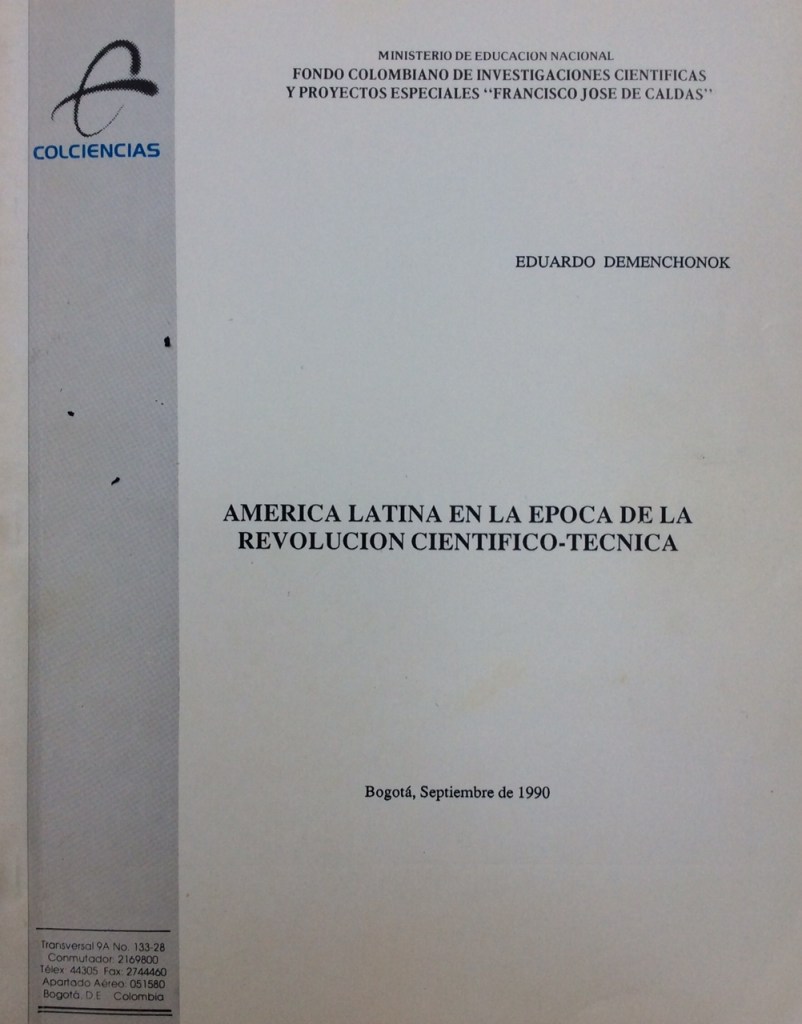
Según el Convenio de cooperación científica entre COLCIENCIAS y la Academia de Ciencias de Rusia, el filósofo ruso Eduardo Demenchónok, investigador mayor del Instituto de Filosofía de la misma Academia, dictó un ciclo de conferencias en varias universidades de Colombia. Esta Entidad publica el presente texto, correspondiente a algunas de sus conferencias, dedicadas al análisis socio-filosófico de los procesos contemporáneos, en especial de América Latina. COLCIENCIAS agradece la valiosa contribución académica del profesor Demenchónok. El contenido de esta publicación es de exclusiva responsabilidad de su autor.
Ministerio de Educación Nacional
Fondo Colombiano de Investigaciones Científicas y
Proyectos Especiales “Francisco José de Caldas.”
Bogotá, Septiembre de 1990
Sovremennaia tekhnokraticheskaia ideologia v SShA [Contemporary technocratic thought in the USA]. Moscow: Izdatel’stvo Nauka [Science], 1984.
Эдуард Деменчонок. Современная технократическая идеология в США. Издательство: Наука, 1984.

Институт философии АН.
В книге дан критический анализ технократической идеологии в США, ее формирования и эволюции. Особенности современной технократической идеологии рассматриваются через ее специфические “антикризисные” функции: “транквилизирующую”, призванную нейтрализовать накал массового недовольства, и “интегрирующую”, направленную на сглаживание социально-классовой разобщенности общества. В этом контексте следует оценивать и выдвигаемые буржуазными идеологами лозунги “мобилизации” и “сплочения” Запада.
Важной задачей исследования является выяснение того, как преломляются теоретические установки технократизма в политической практике США. Анализ социально-философских взглядов ведущих представителей технократизма, подвизавшихся в сфере политической деятельности и оказывавших известное влияние на правительственный курс (З. Бжезинский, С. Хантингтон, Д. Мойнихен и др.), представляет интерес ля практики советско-американских отношений.
Актуальность такого исследования обусловлена тем, что в “философию техники” уходят кори техницистских иллюзий относительно технико-экономических возможностей США, составляющие идеологическую “базу” агрессивных внешнеполитических доктрин. Идеология технократизма образует идеологический фон политики “с позиции силы”, противодействия разрядки, расчетов достичь стратегического превосходства в гонке вооружений.
Не менее существенны и некоторые внутриполитические аспекты проблемы, ее отношение к задачам борьбы за демократизацию американской общественной жизни.
Содержание.
Введение.
ГЛАВА 1. У истоков технократической идеологии.
– Радикальная утопия Т. Веблена. – Несостоявшийся “революционный переворот”.
ГЛАВА 2. В поисках “символа веры”.
– Полемика о судьбах идеологии. – “Некоммунистический манифест” технократизма. – “Техноструктура” и демократия.
ГЛАВА 3. Технократические утопии и диалектика общественного прогресса.
– Кризис и антикризисная идеология. – Научно-техническая революция и социальная революция современности. – Прогресс и диалектика истории.
ГЛАВА 4. Интеллигенция и политика.
– Концепция “нового класса”. – “Меритократия” и противоречия “Большой науки”. – Интеллигенция и “новые” консерваторы – битва за лидерство. – Кризис буржуазной социально-политической организации и технократические проекты его преодоления.
ГЛАВА 5. Технократизм и культура.
– Кризис образования – симптом противоречий между буржуазной организацией и культурой. – “Культурные противоречия капитализма”.
ГЛАВА 6. Проблемы мира и миропорядка в технократической идеологии.
– “Стадии роста” и современный мир. – “Империя – или демократия”. – Транснациональные корпорации: продолжение политики империализма “мирными” средствами. – “Технотронный” миропорядок.
Заключение.
Тираж 2 800 экз.
Издательство: М.: Наука
Переплет: твердый; 240 страниц; 1984 г.
Язык: русский
Ed., Novye tendentsii v zapadnoi sotsial’noi filosofii [New trends in Western social philosophy]. Moscow: Institute of Philosophy RAS, 1988.
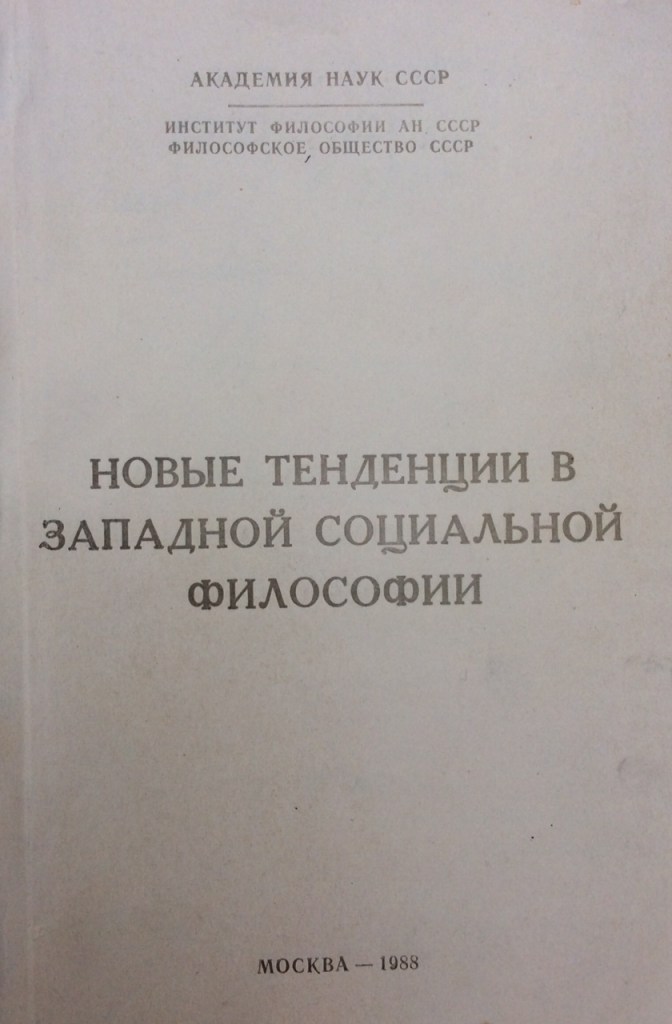
CONTENTS
Demenchonok Edward V. Editorial Introduction.
Chapter One. Soloviev, Erikh J. An attempt of justification of a new philosophy of history in the fundamental ontology of Martin Heidegger.
Chapter Two. Demenchonok Edward V. The theory of “informational society.”
Chapter Tree. Tavrizian, Gayane M. The changing views about the social functions of technology.
Chapter Four. Vdovina Irena S. The problems of power, revolution, and history in the French philosophy of 1970s—1980s.
Chapter Five. Podoroga, Valery A. Power and forms of subjectivity: The archeological search by Michel Foucault.
Chapter Six. Bibikhin, Vladimir V. The crisis of anti-ideology.
Chapter Seven. Marincheshka, Tatiana L. (Bulgaria) and Demenchonok Edward V. Anthony Giddens’s theory of structuring.
Chapter Eight. Kravchenko, Ivan I. The goals of society in the Western-European social philosophy.
Ed., Katolicheskaia filosofia segodnia [On contemporary catholic philosophy]. Moscow: Institute of Philosophy RAS, 1986.

CONTENTS
Demenchonok Edward V. Editorial Introduction.
Chapter One. Gubman, Boris L. “Eternal philosophy” in search for renovation.
Chapter Two. Gaidis A.A. The social-philosophical views of John-Paul II.
Chapter Three. Bibikhin, Vladimir V. Catholic theologians and philosophy.
Chapter Four. Vdovina Irena S. The evolution of social-philosophical ideas in the French personalism.
Chapter Five. Demenchonok Edward V. The problem of cultural-historical creativity in the Latin American Liberation Theology.
Chapter Six. Ovchinnikov V. G. The influence of the catholic universalism on ideas of the “African authenticity.”
 Edward V. Demenchonok